A social employee is a worker operating within a social business model. Following an organization's social computing guidelines, social employees use social media tools both for internal workflow and collaboration purposes and for external engagement with customers, prospects and stakeholders through a combination of social media marketing, content marketing, social marketing, and social selling. Social employee programs are considered to be as much about culture and engagement as they are about business processes and best practices. In addition to increased leads and sales, social employee best practices are said to improve business outcomes important to social media marketing, such as increased connections and web traffic, improved brand identification and "chatter", and better customer advocacy. == Overview == The term "social employee" was first introduced to describe those exhibiting the emerging characteristics of workers operating under a social business model. The term is often used interchangeably with similar designations like "employee advocate" or "social employee advocate". Crucial to the perceived value of the social employee is the concept of the digital footprint. While organizations are able to generate large bases of followers through social media, research shows that brand marketing and engagement efforts through these networks are not as effective as those of individual employees. In fact, some research indicates that employee experts are more trusted than any other member of an organization. Because of this, social employee programs are designed to train, empower, and support employee engagement efforts in the hopes of authentically engaging larger communities, increasing the frequency of shares, reviews, and other forms of "earned media" and expanding the brand's presence on the web. == The personal or employee brand == A foundational concept of the social employee is the idea of the personal or employee brand. This concept first gained popular attention in a 1997 FastCompany article by business leader Tom Peters titled "The Brand Called You". In the article, Peters argued that the premium placed on branding impacted workers' lives to such an extent that creating and cultivating a distinct personal brand had become a professional necessity. According to Peters, doing so built trust, loyalty, visibility, influence, and employability. With increased adoption of social media tools by both businesses and consumers in the early 21st century, many business leaders became increasingly concerned with social engagement, both internally among employees and externally with customers and other stakeholders. While many in the business community acknowledged the potential social tools had for improved collaboration, productivity, and brand messaging, the concern that employees would misrepresent their brand, disclose proprietary information, or otherwise damage their company's reputation or ability to conduct business persisted. As a result, many began to advocate for employee branding as a solution to this problem. This helped give new meaning to the concept of brand ambassadorship, positioning everyday employees in public, and potentially high-profile, engagement roles. == Characteristics == === Engaged === Because social employee advocacy is dependent on the perceived authenticity of the employee, engagement is highly valued in social organizations. Further, data show the measurable impact of employee engagement on organizational productivity and profitability: Happy employees were found to be 12 percent more productive. In one study, engaged employees were found to be 38 percent more likely to produce at above-average rates. In another, organizations with engaged employees had a 19 percent higher than average shareholder return, while organizations with disengaged employees experienced shareholder return that was 44 percent below average. Engaged companies were found to outperform disengaged companies by up to 202 percent. Companies with strong focus on culture were found to have an average 13.9 percent turnover rate, while those with a low focus experience were found to have a 48.4 percent turnover rate. === Flexible job environment and work–life balance === The number of professionals working mobile or remote has risen considerably since 2010. While estimates vary, one study found that number of organizations with mobile or remote employees is expected to rise from 24 percent in 2012 to 89 percent by 2020. Other research has estimated that by 2020, 105.4 million professionals will work remotely in America, about 72.3 percent of the total workforce. This change has been linked to a rise in social technologies, including biometrics, wearables, near-field communications, and augmented reality. Social employees have also put a greater emphasis on work–life balance, with many believing that advances in technology can directly support efforts in this area. Purported benefits of this shift include a more flexible workforce, reduced business costs, and greater organizational leverage in attracting and retaining top talent. === Buys into the brand's story === In 2009, thought leader Simon Sinek presented a speech called "How Great Leaders Inspire Action" at a TEDxPugetSound event. Sinek's central argument in this speech was, "People don't buy what you do. They buy why you do it." This concept—that the story behind a business or product offering is a more compelling sales tool than the product itself—is frequently cited in social media marketing as a way to build authentic connections with stakeholders. However, others have argued that for employees to share a brand's story authentically, they must be engaged in that story themselves, and as a result, many companies have made storytelling part of their culture programs. === Collaborative === An implicit tenet in social business is that social technologies aren't a barrier to productivity, but rather a path to increased connectivity. The shift in enterprise software systems like IBM Connections to incorporate social communication models, such as mentions, wikis, and newsfeeds, reflects the changing communication dynamics within business. With an increase in diversity and sophistication in collaborative software platforms, social organizations have sought to find new creative ways to utilize these tools and secure employee buy-in around them. Crowdsourcing has also become popular in social businesses. Examples include AT&T's program The Innovation Pipeline (TIP), begun in 2009, which has generated over 28,000 ideas that have led to over 75 projects with funding exceeding $44 million. IBM has also put considerable resources into such processes, producing its social computing guidelines through employee crowdsourcing, as well as its Connections platform through the Technology Adoption Program (TAP), a more formalized crowdsourcing initiative. Another popular form of internal collaboration is the hack day, or hackathon. Organizations such as Netflix, Facebook, and IBM use hack days to pull employees out of their day-to-day work environments and encourage them to collaborate in nontraditional ways in an attempt to drive disruptive innovation. Social employees are often encouraged to seek external collaboration opportunities with customers and prospects. For example, Procter & Gamble introduced the Live Well Collaborative to connect with external stakeholders and develop products and services for the 50+ demographic. === Social listener === A social listener is someone who engages in social listening, or social media monitoring, for professional means. Social employees can use social media monitoring for a variety of reasons, including professional development, industry news and trends, and gauging market sentiment. Some have argued that social listening is one of the most important components of social business, as it enables organizations to collect rich market data, make more informed strategic decisions, and respond to customer needs more authentically. === Customer-centric === Advocates of customer-centricity in social business argue that social media has changed the dynamic from one-way brand messaging to shared interactions between brand and customer. Brand and customer engagement is seen as a means of creating more lasting connections with customers and prospects and empowering them to become brand promoters. Customer-centric interactions are seen to have distinct value to brands, as research shows that prospects are far more likely to trust brand-related messaging from a friend or family member than they are from a brand. As a means of building social employees, some social advocates have also called for a broader definition of customer to include the employees themselves. In the book The Pursuit of Social Business Excellence, authors Vala Afshar and Brad Martin made the following argument: A social business operates with the guiding principle that each employee's responsi
Evolvability (computer science)
The term evolvability is a framework of computational learning introduced by Leslie Valiant in his paper of the same name. The aim of this theory is to model biological evolution and categorize which types of mechanisms are evolvable. Evolution is an extension of PAC learning and learning from statistical queries. == General framework == Let F n {\displaystyle F_{n}\,} and R n {\displaystyle R_{n}\,} be collections of functions on n {\displaystyle n\,} variables. Given an ideal function f ∈ F n {\displaystyle f\in F_{n}} , the goal is to find by local search a representation r ∈ R n {\displaystyle r\in R_{n}} that closely approximates f {\displaystyle f\,} . This closeness is measured by the performance Perf ( f , r ) {\displaystyle \operatorname {Perf} (f,r)} of r {\displaystyle r\,} with respect to f {\displaystyle f\,} . As is the case in the biological world, there is a difference between genotype and phenotype. In general, there can be multiple representations (genotypes) that correspond to the same function (phenotype). That is, for some r , r ′ ∈ R n {\displaystyle r,r'\in R_{n}} , with r ≠ r ′ {\displaystyle r\neq r'\,} , still r ( x ) = r ′ ( x ) {\displaystyle r(x)=r'(x)\,} for all x ∈ X n {\displaystyle x\in X_{n}} . However, this need not be the case. The goal then, is to find a representation that closely matches the phenotype of the ideal function, and the spirit of the local search is to allow only small changes in the genotype. Let the neighborhood N ( r ) {\displaystyle N(r)\,} of a representation r {\displaystyle r\,} be the set of possible mutations of r {\displaystyle r\,} . For simplicity, consider Boolean functions on X n = { − 1 , 1 } n {\displaystyle X_{n}=\{-1,1\}^{n}\,} , and let D n {\displaystyle D_{n}\,} be a probability distribution on X n {\displaystyle X_{n}\,} . Define the performance in terms of this. Specifically, Perf ( f , r ) = ∑ x ∈ X n f ( x ) r ( x ) D n ( x ) . {\displaystyle \operatorname {Perf} (f,r)=\sum _{x\in X_{n}}f(x)r(x)D_{n}(x).} Note that Perf ( f , r ) = Prob ( f ( x ) = r ( x ) ) − Prob ( f ( x ) ≠ r ( x ) ) . {\displaystyle \operatorname {Perf} (f,r)=\operatorname {Prob} (f(x)=r(x))-\operatorname {Prob} (f(x)\neq r(x)).} In general, for non-Boolean functions, the performance will not correspond directly to the probability that the functions agree, although it will have some relationship. Throughout an organism's life, it will only experience a limited number of environments, so its performance cannot be determined exactly. The empirical performance is defined by Perf s ( f , r ) = 1 s ∑ x ∈ S f ( x ) r ( x ) , {\displaystyle \operatorname {Perf} _{s}(f,r)={\frac {1}{s}}\sum _{x\in S}f(x)r(x),} where S {\displaystyle S\,} is a multiset of s {\displaystyle s\,} independent selections from X n {\displaystyle X_{n}\,} according to D n {\displaystyle D_{n}\,} . If s {\displaystyle s\,} is large enough, evidently Perf s ( f , r ) {\displaystyle \operatorname {Perf} _{s}(f,r)} will be close to the actual performance Perf ( f , r ) {\displaystyle \operatorname {Perf} (f,r)} . Given an ideal function f ∈ F n {\displaystyle f\in F_{n}} , initial representation r ∈ R n {\displaystyle r\in R_{n}} , sample size s {\displaystyle s\,} , and tolerance t {\displaystyle t\,} , the mutator Mut ( f , r , s , t ) {\displaystyle \operatorname {Mut} (f,r,s,t)} is a random variable defined as follows. Each r ′ ∈ N ( r ) {\displaystyle r'\in N(r)} is classified as beneficial, neutral, or deleterious, depending on its empirical performance. Specifically, r ′ {\displaystyle r'\,} is a beneficial mutation if Perf s ( f , r ′ ) − Perf s ( f , r ) ≥ t {\displaystyle \operatorname {Perf} _{s}(f,r')-\operatorname {Perf} _{s}(f,r)\geq t} ; r ′ {\displaystyle r'\,} is a neutral mutation if − t < Perf s ( f , r ′ ) − Perf s ( f , r ) < t {\displaystyle -t<\operatorname {Perf} _{s}(f,r')-\operatorname {Perf} _{s}(f,r)
Fyre (software)
Fyre, formerly de Jong Explorer, is a cross-platform tool for producing artwork based on histograms of iterated chaotic functions. It implements the Peter de Jong map in a fixed function pipeline through either a GTK GUI frontend, or a command line facility for easier rendering of high-resolution, high quality images. The program was renamed from de Jong Explorer to Fyre simply because 'It wasn't taken yet' and so that in the future, it could support more functions than just the standard Peter de Jong map. Fyre features a sidebar on the left to which the user can input the required variables and on the right is displayed the result of the equation. == Extra features == Additional image manipulation tools such as Gaussian blurs and Gamma controls are included in the program. The advantage to using them directly within Fyre is that the image accuracy and quality do not decline. Fyre features animation capabilities so that a user can link together several maps and create uncompressed AVIs from them. However, the uncompressed animation files are very large and so should be compressed with a separate tool, such as mencoder. == Peter de Jong Map == For most values of a,b,c and d the point (x,y) moves chaotically. The resulting image is a map of the probability that the point lies within the area represented by each pixel. Therefore, the longer that the user lets Fyre render for, the larger the probability map becomes and the more accurate the resulting image.
Boris FX
Boris FX is a visual effects, video editing, photography, and audio software plug-in developer based in Miami, Florida, USA. The developer is known for its flagship products, Continuum (formerly Boris Continuum Complete/BCC), Sapphire, Mocha, and Silhouette. Boris FX creates plug-in tools for feature film, broadcast television, and multimedia post-production workflows. The plug-ins are compatible with various NLEs, including Adobe After Effects and Premiere Pro, Avid Media Composer, Apple Final Cut Pro, and OFX hosts such as Autodesk Flame, Foundry Nuke, Blackmagic Design DaVinci Resolve and Fusion, and VEGAS Pro. Boris FX has incorporated artificial intelligence into its software, introducing features for noise reduction, rotoscoping, upscaling, and masking. The company has acquired technologies via mergers and acquisitions from Imagineer Systems, GenArts, Silhouette FX, Digital Film Tools, CrumplePop and Andersson Technologies to expand its visual effects, editing, photography, and audio tools. == History == Boris FX was founded in 1995 by Boris Yamnitsky. The former Media 100 engineer (a member of the original Media 100 launch team in 1993) released “Boris FX,” the first plug-in-based digital video effects (DVE) for Adobe Premiere and Media 100, in 1995. The plug-in won Best of Show at Apple Macworld in Boston, MA that same year. The Boris FX Suite includes a range of visual effects and post-production tools, such as Sapphire, Continuum, Mocha Pro, Silhouette, SynthEyes, CrumplePop, Optics, and Particle Illusion. == Media 100 == In October 2005, Yamnitsky acquired Media 100 the company that launched his plug-in career. Boris FX had a long relationship with Media 100 which bundled Boris RED software as its main titling and compositing solution. Media 100's video editing software is available as freeware for macOS. == Continuum == Continuum is a visual effect and compositing plugin suite that includes a library of over 300 effects and more than 40 transitions, including tools for image restoration, compositing, titling, particle generation, and stylized effects, along with features such as lens flares, lighting effects, and cinematic color grading presets. A key component of Continuum is its integration with the Mocha planar tracking and masking system, enabling advanced tracking and rotoscoping within the effects. The suite also includes Particle Illusion, a real-time particle generator used for creating visual effects such as explosions, smoke, and abstract motion graphics, as well as Primatte Studio, a chroma keying and compositing toolset for green screen and blue screen workflows. Continuum supports GPU acceleration and offers compatibility with HDR and 360/VR content. Regular updates introduce new effects, presets, and performance enhancements to expand its capabilities. In October 2018, Continuum relaunched Particle Illusion, a Mocha Essentials workflow with magnetic edge-snapping, and updates to Title Studio. In October 2019, Continuum introduced Corner Pin Studio with built-in Mocha tracking for quick screen replacement and inserts, 6 stylized transitions, and 4 creative effects. In October 2020, Continuum released an update that included over 80 GPU-accelerated effects such as film stocks, color grades, optical filter simulations, and a digital gobo library. The update also introduced a custom FX Editor interface, real-time particles, and more than 1,000 drag-and-drop presets. In November 2021, it added multi-frame rendering for After Effects, native Apple M1 support, fluid dynamics in Particle Illusion, and 60 color-grade presets. In October 2022, the software introduced 10 additional transitions, a revised Particle Illusion workflow, an atmospheric glow effect, and more than 250 curated presets. Continuum plugins have been used in television, streaming, and film projects, including A Black Lady Sketch Show (HBO/HBO Max), Star Trek: Discovery (CBS), Andor (Disney+), The Curse of Oak Island (History Channel), Keeping up with the Kardashians (E!), This Old House (PBS), Ms. Marvel (Disney+), MasterChef (Fox), WipeOut (TBS), The Boys (Prime Video), and The Today Show (NBC). == Mocha Pro == In December 2014, Boris FX merged with Imagineer Systems, the UK-based developer of the Academy Award-winning planar motion tracking software, Mocha Pro. Mocha Pro's features include planar tracking (motion tracking), rotoscoping, image stabilization, 3D camera tracking, and object removal. In June 2016, Mocha released (v5) which introduced Mocha Pro's tools as plug-ins for Adobe After Effects and Premiere Pro, Avid Media Composer, and OFX hosts Foundry's NUKE, Blackmagic Design Fusion, VEGAS Pro, and HitFilm. A simplified version, Mocha AE, is included with Adobe After Effects Creative Cloud and has been bundled with the software since CS4. A similar version is also available with HitFilm Pro from FXhome and VEGAS Pro. Mocha's tracking SDK is integrated into other visual effects tools, including SAM Quantel Pablo Rio, Silhouette FX, CoreMelt, and Motion VFX. Mocha Pro has been used in various film and television productions, including Birdman, Black Swan, the Harry Potter series, The Hobbit, Star Wars, The Mandalorian, Star Trek: Discovery, and The Umbrella Academy. It has also been employed in projects such as Gone Girl, The Hunger Games: Mockingjay – Part 1, Game of Thrones, and House of Cards. == Sapphire == GenArts, founded by Karl Sims in 1996, developed visual effects plug-ins that were used by studios and post-production facilities. In September 2016, Boris FX merged with former competitor, GenArts, Inc., developer of Sapphire high-end visual effects plug-ins, to expand its suite of motion graphics and VFX tools. The merger brought Sapphire alongside Boris Continuum Complete (BCC) and Mocha Pro, integrating these tools for film and television post-production. The Sapphire suite includes a library of over 270 effects and transitions, organized into categories such as lighting, stylization, distortions, textures, and transitions. Commonly used effects include glows, lens flares, film looks, and blurs. The plug-ins are designed to be GPU-accelerated, allowing for improved rendering performance and real-time previews in supported host applications. A central feature of Sapphire is the Builder tool, a node-based workspace that allows users to create custom effects and transitions by combining multiple Sapphire plug-ins. This enables a high level of creative flexibility and reusability, making it a popular tool for both editors and VFX artists. Sapphire also integrates with Mocha, Boris FX's planar tracking and masking system, allowing for advanced control of visual elements within an effect. In October 2017, Boris FX released its first new version of Sapphire since the GenArts acquisition. Sapphire (v11) now includes integrated Mocha tracking and masking tools. Sapphire is available for Adobe, Avid, the Autodesk Flame family, and OFX hosts including Blackmagic DaVinci Resolve and Fusion, and Foundry's NUKE. As part of the merger, Boris FX acquired the rights to Particle Illusion. In 2018, Boris FX reintroduced the product to the larger NLE/Compositing market. Sapphire's plug-ins transitioned from C to C++ to improve performance and support higher-resolution visual effects. This update enhanced floating-point calculations, compatibility with film editing APIs, and integration with NVIDIA's CUDA for faster rendering. The plug-ins have been used in various films, including Avatar, the Harry Potter and the Prisoner of Azkaban, Iron Man, The Lord of the Rings, The Matrix trilogy, Titanic, and X-Men. == Particle Illusion == As part of the merger with GenArts in 2016, Boris FX acquired the rights to the Particle Illusion (formerly particleIllusion) product, a storied particle system from the original developer Alan Lorence, the founder of Wondertouch. In 2018, Boris FX released a redesigned version of the product to a larger NLE/compositing market as part of Continuum (2019). The new Particle Illusion plug-in supports Adobe, Avid, and many OFX hosts. == Silhouette == In September 2019, Boris FX merged with SilhouetteFX, Academy Award-winning developer of Silhouette, a high-end digital paint, advanced rotoscoping, motion tracking, and node-based compositing application for visual effects in film post-production. The acquisition integrated Silhouette's advanced rotoscoping and paint technology, recognized by the Academy of Motion Pictures, into Boris FX's suite of products, alongside Sapphire, Continuum, and Mocha Pro. In May 2021, Boris FX released Silhouette 2021, the first version of Silhouette released by Boris FX to function both as a standalone application and as a plug-in for Adobe, Autodesk, Nuke, and other OFX hosts. Silhouette has been used in the visual effects of films such as Avatar, Avengers: Infinity War, Blade Runner 2049, Ex Machina, and Interstellar. == Optics == In June 2020, Boris FX launched Optics, its first plugin deve
Tensor operator
In pure and applied mathematics, quantum mechanics and computer graphics, a tensor operator generalizes the notion of operators which are scalars and vectors. A special class of these are spherical tensor operators which apply the notion of the spherical basis and spherical harmonics. The spherical basis closely relates to the description of angular momentum in quantum mechanics and spherical harmonic functions. The coordinate-free generalization of a tensor operator is known as a representation operator. == The general notion of scalar, vector, and tensor operators == In quantum mechanics, physical observables that are scalars, vectors, and tensors, must be represented by scalar, vector, and tensor operators, respectively. Whether something is a scalar, vector, or tensor depends on how it is viewed by two observers whose coordinate frames are related to each other by a rotation. Alternatively, one may ask how, for a single observer, a physical quantity transforms if the state of the system is rotated. Consider, for example, a system consisting of a molecule of mass M {\displaystyle M} , traveling with a definite center of mass momentum, p z ^ {\displaystyle p{\mathbf {\hat {z}} }} , in the z {\displaystyle z} direction. If we rotate the system by 90 ∘ {\displaystyle 90^{\circ }} about the y {\displaystyle y} axis, the momentum will change to p x ^ {\displaystyle p{\mathbf {\hat {x}} }} , which is in the x {\displaystyle x} direction. The center-of-mass kinetic energy of the molecule will, however, be unchanged at p 2 / 2 M {\displaystyle p^{2}/2M} . The kinetic energy is a scalar and the momentum is a vector, and these two quantities must be represented by a scalar and a vector operator, respectively. By the latter in particular, we mean an operator whose expected values in the initial and the rotated states are p z ^ {\displaystyle p{\mathbf {\hat {z}} }} and p x ^ {\displaystyle p{\mathbf {\hat {x}} }} . The kinetic energy on the other hand must be represented by a scalar operator, whose expected value must be the same in the initial and the rotated states. In the same way, tensor quantities must be represented by tensor operators. An example of a tensor quantity (of rank two) is the electrical quadrupole moment of the above molecule. Likewise, the octupole and hexadecapole moments would be tensors of rank three and four, respectively. Other examples of scalar operators are the total energy operator (more commonly called the Hamiltonian), the potential energy, and the dipole-dipole interaction energy of two atoms. Examples of vector operators are the momentum, the position, the orbital angular momentum, L {\displaystyle {\mathbf {L} }} , and the spin angular momentum, S {\displaystyle {\mathbf {S} }} . (Fine print: Angular momentum is a vector as far as rotations are concerned, but unlike position or momentum it does not change sign under space inversion, and when one wishes to provide this information, it is said to be a pseudovector.) Scalar, vector and tensor operators can also be formed by products of operators. For example, the scalar product L ⋅ S {\displaystyle {\mathbf {L} }\cdot {\mathbf {S} }} of the two vector operators, L {\displaystyle {\mathbf {L} }} and S {\displaystyle {\mathbf {S} }} , is a scalar operator, which figures prominently in discussions of the spin–orbit interaction. Similarly, the quadrupole moment tensor of our example molecule has the nine components Q i j = ∑ α q α ( 3 r α , i r α , j − r α 2 δ i j ) . {\displaystyle Q_{ij}=\sum _{\alpha }q_{\alpha }\left(3r_{\alpha ,i}r_{\alpha ,j}-r_{\alpha }^{2}\delta _{ij}\right).} Here, the indices i {\displaystyle i} and j {\displaystyle j} can independently take on the values 1, 2, and 3 (or x {\displaystyle x} , y {\displaystyle y} , and z {\displaystyle z} ) corresponding to the three Cartesian axes, the index α {\displaystyle \alpha } runs over all particles (electrons and nuclei) in the molecule, q α {\displaystyle q_{\alpha }} is the charge on particle α {\displaystyle \alpha } , and r α , i {\displaystyle r_{\alpha ,i}} is the i {\displaystyle i} -th component of the position of this particle. Each term in the sum is a tensor operator. In particular, the nine products r α , i r α , j {\displaystyle r_{\alpha ,i}r_{\alpha ,j}} together form a second rank tensor, formed by taking the outer product of the vector operator r α {\displaystyle {\mathbf {r} }_{\alpha }} with itself. == Rotations of quantum states == === Quantum rotation operator === The rotation operator about the unit vector n (defining the axis of rotation) through angle θ is U [ R ( θ , n ^ ) ] = exp ( − i θ ℏ n ^ ⋅ J ) {\displaystyle U[R(\theta ,{\hat {\mathbf {n} }})]=\exp \left(-{\frac {i\theta }{\hbar }}{\hat {\mathbf {n} }}\cdot \mathbf {J} \right)} where J = (Jx, Jy, Jz) are the rotation generators (also the angular momentum matrices): J x = ℏ 2 ( 0 1 0 1 0 1 0 1 0 ) J y = ℏ 2 ( 0 i 0 − i 0 i 0 − i 0 ) J z = ℏ ( − 1 0 0 0 0 0 0 0 1 ) {\displaystyle J_{x}={\frac {\hbar }{\sqrt {2}}}{\begin{pmatrix}0&1&0\\1&0&1\\0&1&0\end{pmatrix}}\,\quad J_{y}={\frac {\hbar }{\sqrt {2}}}{\begin{pmatrix}0&i&0\\-i&0&i\\0&-i&0\end{pmatrix}}\,\quad J_{z}=\hbar {\begin{pmatrix}-1&0&0\\0&0&0\\0&0&1\end{pmatrix}}} and let R ^ = R ^ ( θ , n ^ ) {\displaystyle {\widehat {R}}={\widehat {R}}(\theta ,{\hat {\mathbf {n} }})} be a rotation matrix. According to the Rodrigues' rotation formula, the rotation operator then amounts to U [ R ( θ , n ^ ) ] = 1 1 − i sin θ ℏ n ^ ⋅ J − 1 − cos θ ℏ 2 ( n ^ ⋅ J ) 2 . {\displaystyle U[R(\theta ,{\hat {\mathbf {n} }})]=1\!\!1-{\frac {i\sin \theta }{\hbar }}{\hat {\mathbf {n} }}\cdot \mathbf {J} -{\frac {1-\cos \theta }{\hbar ^{2}}}({\hat {\mathbf {n} }}\cdot \mathbf {J} )^{2}.} An operator Ω ^ {\displaystyle {\widehat {\Omega }}} is invariant under a unitary transformation U if Ω ^ = U † Ω ^ U ; {\displaystyle {\widehat {\Omega }}={U}^{\dagger }{\widehat {\Omega }}U;} in this case for the rotation U ^ ( R ) {\displaystyle {\widehat {U}}(R)} , Ω ^ = U ( R ) † Ω ^ U ( R ) = exp ( i θ ℏ n ^ ⋅ J ) Ω ^ exp ( − i θ ℏ n ^ ⋅ J ) . {\displaystyle {\widehat {\Omega }}={U(R)}^{\dagger }{\widehat {\Omega }}U(R)=\exp \left({\frac {i\theta }{\hbar }}{\hat {\mathbf {n} }}\cdot \mathbf {J} \right){\widehat {\Omega }}\exp \left(-{\frac {i\theta }{\hbar }}{\hat {\mathbf {n} }}\cdot \mathbf {J} \right).} === Angular momentum eigenkets === The orthonormal basis set for total angular momentum is | j , m ⟩ {\displaystyle |j,m\rangle } , where j is the total angular momentum quantum number and m is the magnetic angular momentum quantum number, which takes values −j, −j + 1, ..., j − 1, j. A general state within the j subspace | ψ ⟩ = ∑ m c j m | j , m ⟩ {\displaystyle |\psi \rangle =\sum _{m}c_{jm}|j,m\rangle } rotates to a new state by: | ψ ¯ ⟩ = U ( R ) | ψ ⟩ = ∑ m c j m U ( R ) | j , m ⟩ {\displaystyle |{\bar {\psi }}\rangle =U(R)|\psi \rangle =\sum _{m}c_{jm}U(R)|j,m\rangle } Using the completeness condition: I = ∑ m ′ | j , m ′ ⟩ ⟨ j , m ′ | {\displaystyle I=\sum _{m'}|j,m'\rangle \langle j,m'|} we have | ψ ¯ ⟩ = I U ( R ) | ψ ⟩ = ∑ m m ′ c j m | j , m ′ ⟩ ⟨ j , m ′ | U ( R ) | j , m ⟩ {\displaystyle |{\bar {\psi }}\rangle =IU(R)|\psi \rangle =\sum _{mm'}c_{jm}|j,m'\rangle \langle j,m'|U(R)|j,m\rangle } Introducing the Wigner D matrix elements: D ( R ) m ′ m ( j ) = ⟨ j , m ′ | U ( R ) | j , m ⟩ {\displaystyle {D(R)}_{m'm}^{(j)}=\langle j,m'|U(R)|j,m\rangle } gives the matrix multiplication: | ψ ¯ ⟩ = ∑ m m ′ c j m D m ′ m ( j ) | j , m ′ ⟩ ⇒ | ψ ¯ ⟩ = D ( j ) | ψ ⟩ {\displaystyle |{\bar {\psi }}\rangle =\sum _{mm'}c_{jm}D_{m'm}^{(j)}|j,m'\rangle \quad \Rightarrow \quad |{\bar {\psi }}\rangle =D^{(j)}|\psi \rangle } For one basis ket: | j , m ¯ ⟩ = ∑ m ′ D ( R ) m ′ m ( j ) | j , m ′ ⟩ {\displaystyle |{\overline {j,m}}\rangle =\sum _{m'}{D(R)}_{m'm}^{(j)}|j,m'\rangle } For the case of orbital angular momentum, the eigenstates | ℓ , m ⟩ {\displaystyle |\ell ,m\rangle } of the orbital angular momentum operator L and solutions of Laplace's equation on a 3d sphere are spherical harmonics: Y ℓ m ( θ , ϕ ) = ⟨ θ , ϕ | ℓ , m ⟩ = ( 2 ℓ + 1 ) 4 π ( ℓ − m ) ! ( ℓ + m ) ! P ℓ m ( cos θ ) e i m ϕ {\displaystyle Y_{\ell }^{m}(\theta ,\phi )=\langle \theta ,\phi |\ell ,m\rangle ={\sqrt {{(2\ell +1) \over 4\pi }{(\ell -m)! \over (\ell +m)!}}}\,P_{\ell }^{m}(\cos {\theta })\,e^{im\phi }} where Pℓm is an associated Legendre polynomial, ℓ is the orbital angular momentum quantum number, and m is the orbital magnetic quantum number which takes the values −ℓ, −ℓ + 1, ... ℓ − 1, ℓ The formalism of spherical harmonics have wide applications in applied mathematics, and are closely related to the formalism of spherical tensors, as shown below. Spherical harmonics are functions of the polar and azimuthal angles, ϕ and θ respectively, which can be conveniently collected into a unit vector n(θ, ϕ) pointing in the direction of those angles, in the Cartesian basis it is: n ^ ( θ , ϕ ) = cos ϕ sin θ e x + s
Distributed Common Ground System
The Distributed Common Ground System (DCGS) is a system which produces military intelligence for multiple branches of the American military. == DCGS Programs == DCGS-N - DCGS for the United States Navy DCGS-A - DCGS for the United States Army AF DCGS - DCGS for the United States Air Force DCGS-MC - DCGS for the United States Marine Corps DCGS-SOF - DCGS for the United States Special Operations Forces IS&A Support Center - DCGS-A Help Desk for the United States Army - https://dcgsahelp.max.gov/ - Max.gov sunset 15 December 2023 == Description == While in U.S. Air Force use, the system produces intelligence collected by the U-2 Dragonlady, RQ-4 Global Hawk, MQ-9 Reaper and MQ-1 Predator. The previous system of similar use was the Deployable Ground Station (DGS), which was first deployed in July 1994. Subsequent version of DGS were developed from 1995 through 2009. Although officially designated a "weapons system", it consists of computer hardware and software connected together in a computer network, devoted to processing and dissemination of information such as images. The 480th Intelligence, Surveillance and Reconnaissance Wing of the Air Combat Command operates and maintains the USAF system. A plan envisioned in 1998 was to develop interoperable systems for the Army and Navy, in addition to the Air Force. By 2006, version 10.6 was deployed by the Air Force, and a version known as DCGS-A was developed for the Army. After a 2010 report by General Michael T. Flynn, the program was intended to use cloud computing and be as easy to use as an iPad, which soldiers over a few years were commonly using. By April 2011, project manager Colonel Charles Wells announced version 3 of the Army system (code named "Griffin") was being deployed in the US war in Afghanistan. In January 2012, the United States Army Communications-Electronics Research, Development and Engineering Center hosted a meeting based on the DCGS-A early experience. It brought together technology providers in the hope of developing more integrated systems using cloud computing with open architectures, compared to previously specialized custom-built systems. A major contractor was Lockheed Martin, with computers supplied by Silicon Graphics International out of its Chippewa Falls, Wisconsin office. Software known as the Analyst's Notebook, originally developed by i2 Limited, was included in DCGS-A. IBM acquired i2 in 2011. Some US Army personnel reported using a Palantir Technologies product to improve their ability to predict locations of improvised explosive devices. An April 2012 report recommending further study after initial success. Palantir software was rated easy to use, but did not have the flexibility and wide number of data sources of DCGS-A. In July 2012, Congressman Duncan D. Hunter (from California, the state where Palantir is based) complained of US DoD obstacles to its wider use. Although a limited test in August 2011 by the Test and Evaluation Command had recommended deployment, operation problems of DCGS-A included the baseline system was "not operationally effective" with reboots on average about every 8 hours. A set of improvements was identified in November 2012. The press reported some of the shortcomings uncovered by General Genaro Dellarocco in the tests. The ambitious goal of integrating 473 data sources for 75 million reports proved to be challenging, after spending an estimated $2.3 billion on the Army system alone. In May 2013 Politico reported that Palantir lobbyists and some anonymous returning veterans continued to advocate the use of its software, despite its interoperability limits. In particular, members of special forces and US Marines were not required to use the official Army system. Similar stories appeared in other publications, with Army representatives (such as Major General Mary A. Legere) citing the limitations of various systems. Congressman Hunter was a member of the House Armed Services Committee which required a review of the program, after two other members of congress sent an open letter to Secretary of Defense Leon Panetta. The Senate Defense Appropriations Subcommittee included testimony from Army Chief of Staff General Ray Odierno. The 130th Engineer Brigade (United States) has found the system to be "unstable, slow, not friendly and a major hindrance to operations". The equivalent system for the United States Navy was planned for initial deployment by 2015, and within a shipboard network called Consolidated Afloat Networks and Enterprise Services (CANES) by 2016. Some early testing was announced in 2009 aboard the aircraft carrier USS Harry Truman. A portion of the software, a distributed data framework for the DCGS integration backbone (DIB) version 4, was submitted to an open-source software repository of the Codice Foundation on GitHub. The framework was new for DIB version 4, replacing the legacy DIB portal with an Ozone Widget Framework interface. It was written in the Java programming language. == DCGS-A == Distributed Common Ground System-Army (DCGS-A) is the United States Army's primary system to post data, process information, and disseminate Intelligence, Surveillance and Reconnaissance (ISR) information about the threat, weather, and terrain to echelons. DCGS-A provides commanders the ability to task battle-space sensors and receive intelligence information from multiple sources. === Promotion === An August 17, 2011, UPI article quoted i2 Chief Executive Officer Robert Griffin who commented on DCGS-A's best-of-breed approach to development. The article detailed the Army contracting with i2 for Analyst's Notebook software. "With its open architecture, Analyst's Notebook supports the Army's strategy to employ and integrate best-of-breed solutions from across the industry to meet the dynamic needs users face in the field on a daily basis." A February 1, 2012, article in the Army web page quoted Mark Kitz, DCGS-A technical director. DCGS-A "uses the latest in cloud technology to rapidly gather, collaborate and share intelligence data from multiple sources to deliver a common operating picture. DCGS-A is able to rapidly adapt to changing operational environments by leveraging an iterative development model and open architecture allowing for collaboration with multiple government, industry and academic partners." A July 2012 article in SIGNAL Magazine, monthly publication of the Armed Forces Communications and Electronics Association, promoted DCGS-A as taking advantage of technological environments with which young soldiers are familiar. The article quoted the DCGS-A program manager, Col. Charles Wells on the systems benefits. The article also included Lockheed Martin's DCGS-A program manager. The Milwaukee Journal Sentinel published an article May 4, 2012, about Wisconsin-located companies helping DCGS-A with cloud computing technology. The article promoted the speed when cloud computing processes intelligence and cost savings by analyzing data in the field. === The U.S. Army's 2011 Posture Statement === The U.S. Army released its 2011 Army Posture Statement March 2. It included a statement on DCGS-A: “The Distributed Common Ground System-Army (DCGS-A) is the Army's premier intelligence, surveillance, and reconnaissance (ISR) enterprise for the tasking of sensors, analysis and processing of data, exploitation of data, and dissemination of intelligence (TPED) across all echelons. It is the Army component of the larger Defense Intelligence Information Enterprise (DI2E) and interoperable with other Service DCGS programs. Under the DI2E framework, USD (I) hopes to provide COCOM Joint Intelligence Operations Centers (JIOCs) capabilities interoperable with DCGS-A through a Cloud/widget approach. DCGS-A connects tactical, operational, and theater-level commanders to hundreds of intelligence and intelligence-related data sources at all classification levels and allows them to focus efforts of the entire ISR community on their information requirements. === Comparisons === Some Ground Commanders who describe DCGS-A as "unwieldy and unreliable, hard to learn and difficult to use," supporting alternative software from Palantir Technologies. Palantir software supports small unit situational awareness, but is not sufficiently funded to support the broader role that DCGS-A fulfills. == Operators == 480th Intelligence, Surveillance and Reconnaissance Wing 9th Intelligence Squadron 13th Intelligence Squadron 548th Intelligence, Surveillance and Reconnaissance Group 548 Operational Support Squadron 48th Intelligence Squadron 101st Intelligence Squadron 113th Air Support Operations Squadron 127th Command and Control Squadron 161st Intelligence Squadron
Biorobotics
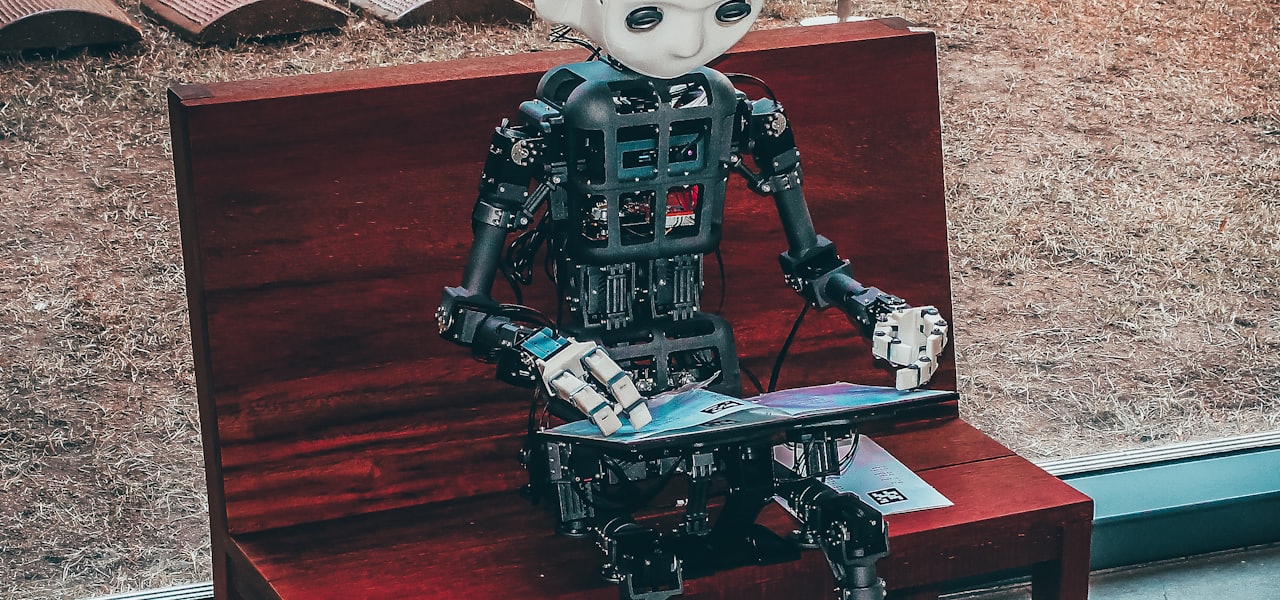
Biorobotics is an interdisciplinary science that combines the fields of biomedical engineering, cybernetics, and robotics to develop new technologies that integrate biology with mechanical systems to develop more efficient communication, alter genetic information, and create machines that imitate biological systems. == Cybernetics == Cybernetics focuses on the communication and system of living organisms and machines that can be applied and combined with multiple fields of study such as biology, mathematics, computer science, engineering, and much more. This discipline falls under the branch of biorobotics because of its combined field of study between biological bodies and mechanical systems. Studying these two systems allows for advanced analysis on the functions and processes of each system as well as the interactions between them. === History === Cybernetic theory is a concept that has existed for centuries, dating back to the era of Plato where he applied the term to refer to the "governance of people". The term cybernetique is seen in the mid-1800s used by physicist André-Marie Ampère. The term cybernetics was popularized in the late 1940s to refer to a discipline that touched on, but was separate, from established disciplines, such as electrical engineering, mathematics, and biology. === Science === Cybernetics is often misunderstood because of the breadth of disciplines it covers. In the early 20th century, it was coined as an interdisciplinary field of study that combines biology, science, network theory, and engineering. Today, it covers all scientific fields with system related processes. The goal of cybernetics is to analyze systems and processes of any system or systems in an attempt to make them more efficient and effective. === Applications === Cybernetics is used as an umbrella term so applications extend to all systems related scientific fields such as biology, mathematics, computer science, engineering, management, psychology, sociology, art, and more. Cybernetics is used amongst several fields to discover principles of systems, adaptation of organisms, information analysis and much more. == Genetic engineering == Genetic engineering is a field that uses advances in technology to modify biological organisms. Through different methods, scientists are able to alter the genetic material of microorganisms, plants and animals to provide them with desirable traits. For example, making plants grow bigger, better, and faster. Genetic engineering is included in biorobotics because it uses new technologies to alter biology and change an organism's DNA for their and society's benefit. === History === Although humans have modified genetic material of animals and plants through artificial selection for millennia (such as the genetic mutations that developed teosinte into corn and wolves into dogs), genetic engineering refers to the deliberate alteration or insertion of specific genes to an organism's DNA. The first successful case of genetic engineering occurred in 1973 when Herbert Boyer and Stanley Cohen were able to transfer a gene with antibiotic resistance to a bacterium. === Science === There are three main techniques used in genetic engineering: The plasmid method, the vector method and the biolistic method. ==== Plasmid method ==== This technique is used mainly for microorganisms such as bacteria. Through this method, DNA molecules called plasmids are extracted from bacteria and placed in a lab where restriction enzymes break them down. As the enzymes do this, some develop a rough edge that resembles that of a staircase which is considered 'sticky' and capable of reconnecting. These 'sticky' molecules are inserted into another bacteria where they will connect to the DNA rings with the altered genetic material. ==== Vector method ==== The vector method is considered a more precise technique than the plasmid method as it involves the transfer of a specific gene instead of a whole sequence. In the vector method, a specific gene from a DNA strand is isolated through restriction enzymes in a laboratory and is inserted into a vector. Once the vector accepts the genetic code, it is inserted into the host cell where the DNA will be transferred. ==== Biolistic method ==== The biolistic method is typically used to alter the genetic material of plants. This method embeds the desired DNA with a metallic particle such as gold or tungsten in a high speed gun. The particle is then bombarded into the plant. Due to the high velocities and the vacuum generated during bombardment, the particle is able to penetrate the cell wall and inserts the new DNA into the cell. === Applications === Genetic engineering has many uses in the fields of medicine, research and agriculture. In the medical field, genetically modified bacteria are used to produce drugs such as insulin, human growth hormones and vaccines. In research, scientists genetically modify organisms to observe physical and behavioral changes to understand the function of specific genes. In agriculture, genetic engineering is extremely important as it is used by farmers to grow crops that are resistant to herbicides and to insects such as BTCorn. == Bionics == Bionics is a medical engineering field and a branch of biorobotics consisting of electrical and mechanical systems that imitate biological systems, such as prosthetics and hearing aids. It's a portmanteau that combines biology and electronics. === History === The history of bionics goes as far back in time as ancient Egypt. A prosthetic toe made out of wood and leather was found on the foot of a mummy. The time period of the mummy corpse was estimated to be from around the fifteenth century B.C. Bionics can also be witnessed in ancient Greece and Rome. Prosthetic legs and arms were made for amputee soldiers. In the early 16th century, a French military surgeon by the name of Ambroise Pare became a pioneer in the field of bionics. He was known for making various types of upper and lower prosthetics. One of his most famous prosthetics, Le Petit Lorrain, was a mechanical hand operated by catches and springs. During the early 19th century, Alessandro Volta further progressed bionics. He set the foundation for the creation of hearing aids with his experiments. He found that electrical stimulation could restore hearing by inserting an electrical implant to the saccular nerve of a patient's ear. In 1945, the National Academy of Sciences created the Artificial Limb Program, which focused on improving prosthetics since there were a large number of World War II amputee soldiers. Since this creation, prosthetic materials, computer design methods, and surgical procedures have improved, creating modern-day bionics. === Science === ==== Prosthetics ==== The important components that make up modern-day prosthetics are the pylon, the socket, and the suspension system. The pylon is the internal frame of the prosthetic that is made up of metal rods or carbon-fiber composites. The socket is the part of the prosthetic that connects the prosthetic to the person's missing limb. The socket consists of a soft liner that makes the fit comfortable, but also snug enough to stay on the limb. The suspension system is important in keeping the prosthetic on the limb. The suspension system is usually a harness system made up of straps, belts or sleeves that are used to keep the limb attached. The operation of a prosthetic could be designed in various ways. The prosthetic could be body-powered, externally-powered, or myoelectrically powered. Body-powered prosthetics consist of cables attached to a strap or harness, which is placed on the person's functional shoulder, allowing the person to manipulate and control the prosthetic as he or she deems fit. Externally-powered prosthetics consist of motors to power the prosthetic and buttons and switches to control the prosthetic. Myoelectrically powered prosthetics are new, advanced forms of prosthetics where electrodes are placed on the muscles above the limb. The electrodes will detect the muscle contractions and send electrical signals to the prosthetic to move the prosthetic. The downside to this type of prosthetic is that if the sensors are not placed correctly on the limb then the electrical impulses will fail to move the prosthetic. TrueLimb is a specific brand of prosthetics that uses myoelectrical sensors which enable a person to have control of their bionic limb. ==== Hearing aids ==== Four major components make up the hearing aid: the microphone, the amplifier, the receiver, and the battery. The microphone takes in outside sound, turns that sound to electrical signals, and sends those signals to the amplifier. The amplifier increases the sound and sends that sound to the receiver. The receiver changes the electrical signal back into sound and sends the sound into the ear. Hair cells in the ear will sense the vibrations from the sound, convert the vibrations into nerve signals, and send it to the brain so